Description
Court-Ready OSINT, Online Evidence, and CSI-CMS Workflow : 05/16/2026 – 06/07/2026
Most investigators do not need another random tool list.
They need a repeatable investigation workflow that helps them move from allegation, to evidence, to documentation, to defensible reporting.
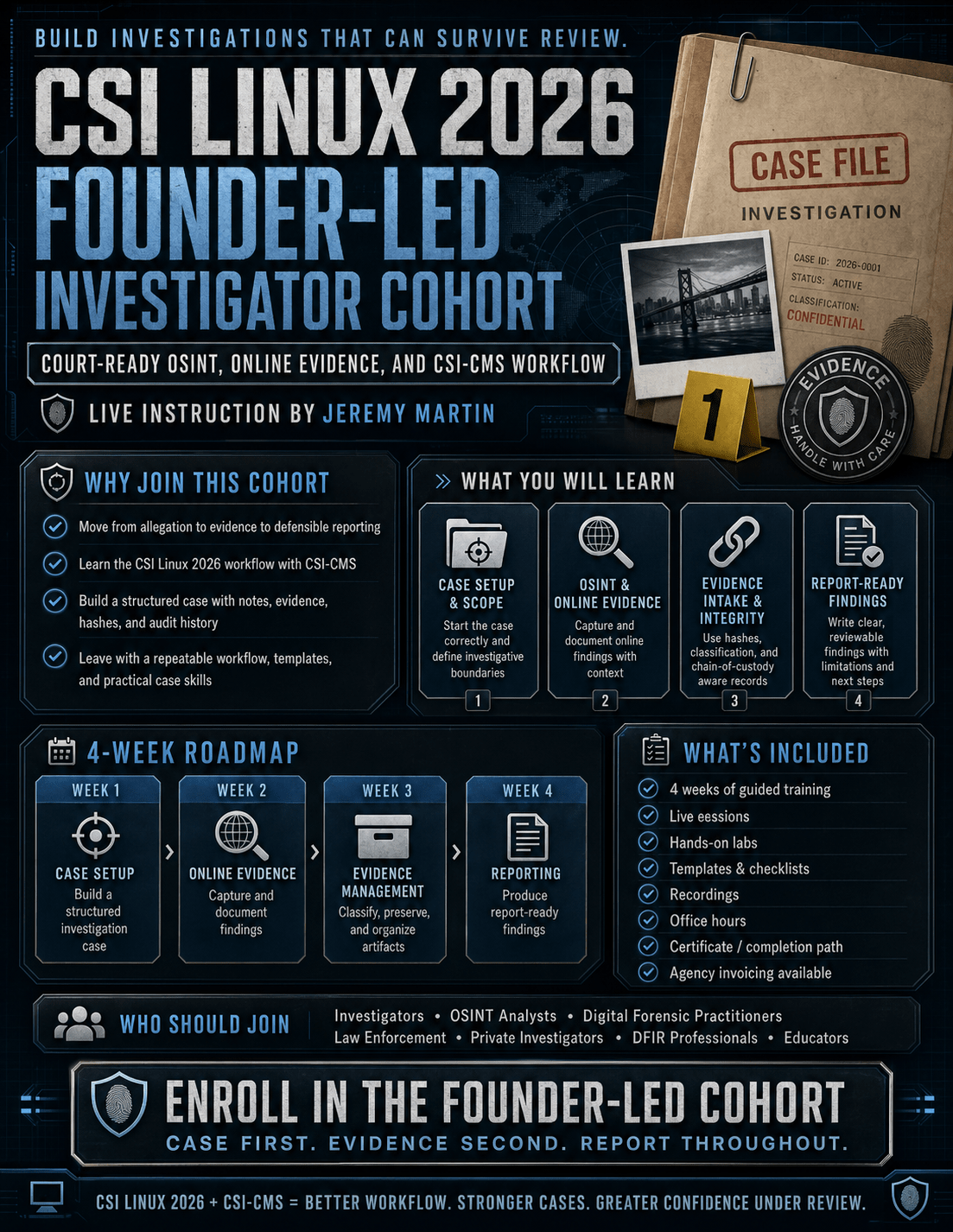
The CSI Linux 2026 Founder-Led Investigator Cohort is a 4-week, hands-on training experience designed for investigators, analysts, forensic practitioners, educators, and agencies that want to become operational with the new CSI Linux 2026 release and the CSI Case Management System.
This cohort teaches the workflow behind the platform:
Case first. Evidence second. Report throughout.
You will learn how to start a structured case, document the allegation and scope, track investigative work, manage notes, intake evidence, preserve integrity, organize findings, and build report-ready conclusions using CSI Linux and CSI-CMS.
This is not a passive video course. This is a guided operational cohort led by Jeremy Martin, built around practical casework, live instruction, labs, templates, checklists, and office hours.
Why This Cohort Matters
Digital investigators often have tools, screenshots, exports, notes, and findings scattered across different places.
That creates risk.
When a case is reviewed, challenged, transferred, taught, or defended, the question is not only:
“What did you find?”
The better question is:
“Can you explain how you found it, when you captured it, how you preserved it, why it matters, and what it does or does not prove?”
That is where workflow matters.
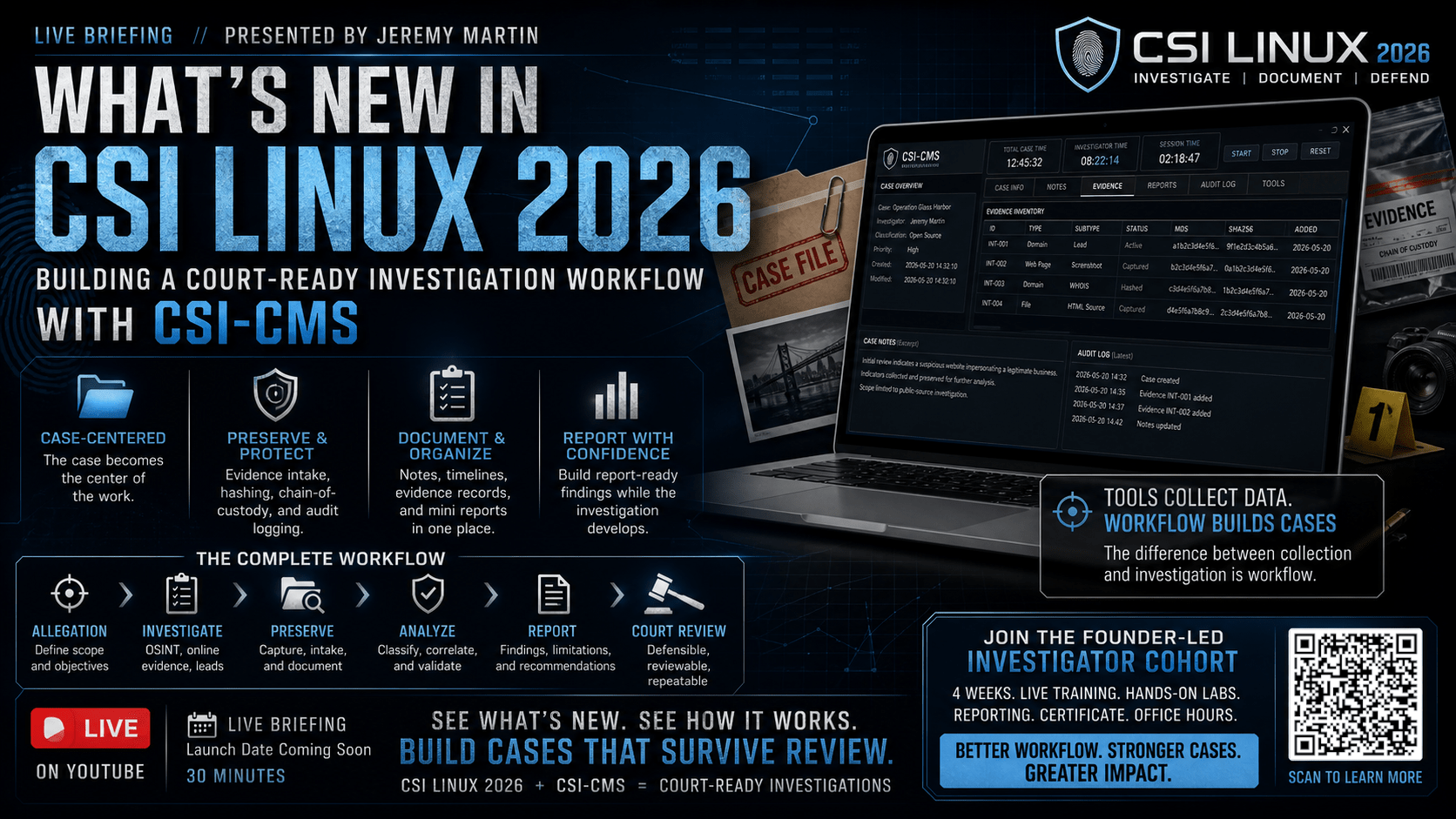
CSI-CMS helps close the investigation gap by giving investigators a structured way to manage:
- Case creation and case metadata
- Investigator and session time tracking
- Case notes and investigator-specific notes
- Evidence intake and classification
- MD5/SHA256 hashing and chain-of-custody fields
- Audit log review
- Report templates and report-ready findings
- Repeatable investigative process
The goal is not more screenshots.
The goal is to build investigations that can survive review.
What You Will Learn
During the 4-week cohort, you will work through a complete fictional investigation using CSI Linux 2026 and CSI-CMS.
You will learn how to:
- Start and structure a new investigation case
- Define the allegation, scope, and investigative boundaries
- Use CSI-CMS as the central case workflow hub
- Track total case time, investigator time, and session time
- Maintain case notes and investigator-specific notes
- Intake evidence into the case structure
- Classify evidence by type, subtype, and investigative relevance
- Preserve artifacts with hash values and chain-of-custody fields
- Distinguish between leads, intelligence, and evidence
- Write findings that avoid overstatement
- Preserve source, time, method, and relevance
- Build report-ready findings during the investigation
- Prepare a final case package with stronger review value
What Makes This Different
This cohort is not built around memorizing tools.
It is built around operational casework.
You will not just learn what CSI Linux contains. You will learn how to use CSI Linux and CSI-CMS to support a professional investigation workflow.
The focus is practical:
| Instead of only learning… | You will learn how to… |
|---|---|
| Tools | Build a repeatable workflow |
| Screenshots | Preserve evidence with context |
| Notes | Maintain case documentation |
| Leads | Classify intelligence and evidence |
| Findings | Write defensible conclusions |
| Exports | Build report-ready outputs |
| Knowledge | Apply a repeatable case process |
CSI-CMS does not replace investigator judgment.
It gives investigators a structure for proving the work.
4-Week Cohort Roadmap
Week 1: CSI Linux 2026 + Case Setup
You will learn how to start a structured investigation in CSI-CMS.
Focus areas:
- CSI Linux 2026 orientation
- CSI-CMS interface and workflow
- Starting and opening cases
- Case metadata
- Allegation and scope statements
- Timeclock workflow
- Case notes and investigator notes
- Audit log awareness
Outcome:
By the end of Week 1, you will have a structured case foundation with allegation, scope, case notes, investigator notes, and active case context.
Week 2: OSINT and Online Evidence
You will learn how to document online findings without losing source context.
Focus areas:
- Public-source investigation discipline
- Online evidence capture concepts
- Source, time, method, and relevance
- Screenshots, saved artifacts, and supporting notes
- Evidence intake in CSI-CMS
- Careful investigative language
- Avoiding unsupported conclusions
Outcome:
By the end of Week 2, you will have collected and documented online artifacts in the case evidence structure.
Week 3: Evidence Management and Findings
You will learn how to organize, classify, and review evidence for reportable use.
Focus areas:
- Evidence type and subtype classification
- Evidence records and evidence index
- Hash values and integrity review
- Chain-of-custody fields
- Leads vs. intelligence vs. evidence
- Linking artifacts to the allegation
- Building mini findings
- Documenting limitations
Outcome:
By the end of Week 3, you will have an organized evidence index and multiple report-ready mini findings.
Week 4: Reporting and Courtroom Readiness
You will learn how to turn documented work into a defensible case report.
Focus areas:
- Report structure
- Methods section
- Findings language
- Limitations and corroboration
- Evidence appendix
- Audit log review
- Final case package preparation
- Explaining your process under scrutiny
Outcome:
By the end of Week 4, you will have a completed training case package with evidence records, notes, findings, limitations, and report-ready output.
What Is Included
Your cohort access includes:
- 4 weeks of guided training
- Live instruction with Jeremy Martin
- CSI Linux 2026 orientation
- CSI-CMS case workflow training
- Hands-on investigation labs
- Practical evidence intake exercises
- OSINT and online evidence workflow practice
- Reporting templates
- Investigation checklists
- Case workflow worksheets
- Certificate or completion path
- Session recordings
- Office hours / Q&A support
- Practical implementation guidance
Who Should Join
This cohort is designed for:
- Digital forensic practitioners
- OSINT analysts
- Law enforcement investigators
- Cybercrime investigators
- Private investigators
- Fraud and SIU teams
- DFIR professionals
- Intelligence analysts
- Cybersecurity instructors
- College and training program educators
- Students preparing for investigative work
- Agencies building repeatable investigation workflows
This is especially useful for anyone whose work must be documented, reviewed, taught, defended, or reproduced.
What You Will Leave With
By the end of the cohort, participants should leave with:
- A completed CSI-CMS training case
- A structured case folder
- Allegation and scope documentation
- Case notes and investigator notes
- Evidence intake records
- Hash and integrity documentation
- Chain-of-custody-aware evidence records
- An evidence index
- Report-ready findings
- Limitations and recommended next steps
- A final case report framework
- Repeatable checklists for future investigations
You will not just watch a demonstration.
You will build the workflow.
The Core Promise
The CSI Linux 2026 Founder-Led Investigator Cohort helps investigators move from scattered activity to structured casework.
You will learn how to use CSI Linux 2026 and CSI-CMS to support a professional investigative process from beginning to end:
Allegation → Case Setup → Evidence Intake → Documentation → Findings → Report → Review
The outcome is simple:
Better workflow.
Stronger cases.
Greater confidence under review.
Join the CSI Linux 2026 Founder-Led Investigator Cohort
If you are ready to move beyond disconnected tools and build a repeatable investigation workflow, this cohort is for you.
Learn the new CSI Linux 2026 environment.
Use CSI-CMS the way it was designed to be used.
Build a complete investigation from allegation to evidence to report.
Leave with practical skills, reusable templates, and a workflow you can apply to future cases.
Enroll now and get operational with CSI Linux 2026 and CSI-CMS.