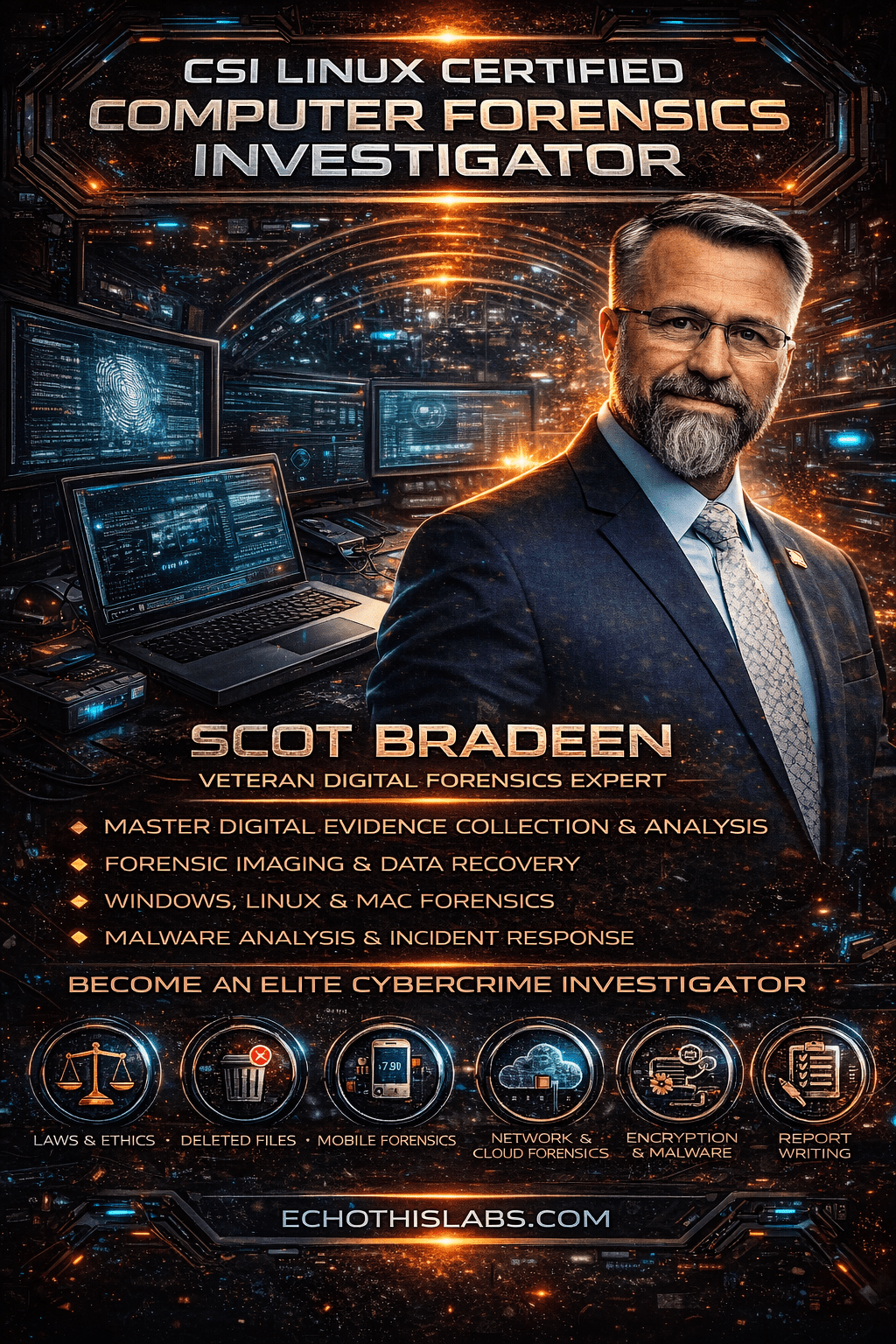
CSI Linux Certified Computer Forensics Investigator (CSIL-CCFI): Instructor Led Evenings Course with Scot Bradeen — May 19, 2026

Evening Computer Forensics Training!

https://shop.csilinux.com/shop/instructor-led-training/master-computer-forensics-with-csi-linux-live-instructor-led-training-csil-ccfi-certification-scot-bradeen/

The CSI Linux Certified Computer Forensic Investigator course and certification is designed to teach investigators how to identify, preserve, analyze, validate, correlate, and defend digital evidence in a structured and court ready manner. It covers the lifecycle of a computer forensics investigation, from foundational concepts and legal authority through evidence handling, workstation preparation, file systems, deleted data, timeline and log analysis, operating system artifacts, internet evidence, memory, mobile, cloud, network attribution, malware, expert testimony, and final case reconstruction. Its purpose is not merely to teach tool use. Its purpose is to teach how to build a defensible forensic case that can withstand technical scrutiny, legal challenge, and courtroom examination.

This course is useful because computer forensic investigations are judged not only by whether evidence is found, but by whether it was acquired, interpreted, preserved, and reported correctly. For digital forensic examiners, investigators, law enforcement, incident responders, and related professionals, the course provides a disciplined framework for evidence integrity, attribution, reconstruction, reporting, and courtroom readiness. It is built to move investigators from foundational understanding to practical capability while preserving scientific thinking, documentation discipline, and operational rigor.

Phase 1. Foundations of Computer Forensics and Investigative Thinking
• Module 1. Introduction to Computer Forensics: Opens the course and frames the purpose, scope, and value of computer forensics in modern investigations.
• Module 2. What is Cyber Forensics? Defines cyber forensics and places it in the broader investigative and evidentiary context.
• Module 3. The Investigation Mindset: Builds the disciplined reasoning and analytical posture required for defensible forensic work.
• Module 4. The Investigation Process: Establishes the overall workflow from allegation through acquisition, analysis, reporting, and testimony.
• Module 5. Digital Evidence, Proof, and Attribution: Explains the relationship between artifacts, evidentiary value, and attribution limits.
• Module 6. Scientific Foundations of Digital Evidence: Connects forensic work to validation, reliability, repeatability, and scientific discipline.
• Module 7. Laws and Ethics: Covers legal authority, ethics, scope, privacy, and the responsibilities of the forensic examiner.

Phase 2. Documentation, Reporting, and Laboratory Readiness
• Module 8. Common Documents in Computer Forensics: Introduces the core documents used to support forensic casework.
• Module 9. Documentation and Case Management: Covers structured recordkeeping, case tracking, and disciplined case file management.
• Module 10. Report Writing: Teaches how to communicate findings clearly, accurately, and defensibly.
• Module 11. Creating a Digital Forensic Workstation: Covers workstation planning, configuration, and readiness for forensic use.
• Module 12. CSI Linux as your Forensic Workstation: Applies workstation principles specifically to CSI Linux as a forensic platform.
• Module 13. Working with Pre-Imaged Evidence: Prepares investigators to work from prepared images in a controlled and repeatable way.
• Module 14. E-Discovery: Connects forensic process to discovery, review, and broader evidentiary production workflows.

Phase 3. Storage, File Systems, and Low-Level Evidence Foundations
• Module 15. How data is written to a drive: Explains how storage behavior affects forensic recovery and interpretation.
• Module 16. File System: Introduces file system structure and forensic relevance.
• Module 17. Slack Space: Covers residual data in slack space and its investigative value.
• Module 18. Deleted Files: Teaches the recovery and interpretation of deleted content.
• Module 19. String/HEX Searching and Regex: Provides practical search techniques for identifying evidence in raw and structured data.
• Module 20. File Analysis: Covers file triage, interpretation, and artifact value assessment.
• Module 21. Timeline Analysis: Teaches time-based correlation of activity across artifacts.
• Module 22. Log Files: Explains the collection and interpretation of logs as forensic evidence.

Phase 4. Evidence Acquisition, Integrity, and Control
• Module 23. Acquiring, Transporting, and Storing Evidence: Covers safe handling and movement of digital evidence.
• Module 24. Forensic Imaging: Teaches image acquisition methods and their evidentiary significance.
• Module 25. Evidence Integrity & Validation: Reinforces validation, hashing, and integrity controls.
• Module 26. Chain of Custody and Evidence Control: Covers documentation and control measures that preserve admissibility.

Phase 5. Operating System and User Environment Artifacts
• Module 27. Windows OS Artifacts: Examines common Windows sources of forensic value.
• Module 28. Windows Registry Forensics: Focuses on registry-based evidence and interpretation.
• Module 29. MAC OS Artifacts: Covers forensic artifacts specific to macOS environments.
• Module 30. Linux OS Artifacts: Covers forensic artifacts specific to Linux systems.
• Module 31. Internet Evidence: Teaches how browser, web, and internet related artifacts support investigations.
• Module 32. Graphics and Image Analysis: Covers the evidentiary and analytical value of image artifacts.
• Module 33. Memory Forensics: Introduces volatile memory acquisition and analysis.

Phase 6. Concealment, Devices, and Modern Technical Environments
• Module 34. Methods of Hiding Data: Surveys concealment techniques used to obscure evidence.
• Module 35. Encryption: Covers encryption in relation to access, interpretation, and forensic limitations.
• Module 36. Anti-Forensics and Evasion: Addresses adversary efforts to frustrate forensic recovery and interpretation.
• Module 37. Mobile Devices: Introduces mobile device evidence and acquisition considerations.
• Module 38. IoT, IIoT, ICS, and SCADA Forensics: Covers emerging and specialized device environments.
• Module 39. Virtualization and Containers: Explains how virtual and containerized environments affect forensic work.
• Module 40. Cloud Forensics: Covers cloud hosted evidence and related acquisition and attribution issues.

Phase 7. Attribution, Correlation, and Advanced Investigative Reconstruction
• Module 41. Network and Account Attribution: Focuses on linking activity to accounts, infrastructure, and actors.
• Module 42. OSINT for Digital Forensics: Connects open-source intelligence methods to forensic case support.
• Module 43. Evidence Correlation and Case Reconstruction: Teaches how to combine artifacts into a defensible case theory.
• Module 44. Timeline Reconstruction and Event Sequencing: Builds event sequencing across systems, artifacts, and timelines.
• Module 45. Hacking and Malware Forensics: Covers malicious activity and malware related forensic artifacts.
• Module 46. Threat Actor Tradecraft and MITRE ATT&CK for Examiners: Connects observed evidence to adversary tradecraft and behavior frameworks.
• Module 47. AI in Computer Forensics: Examines the role, value, and risks of AI in forensic workflows.

Phase 8. Courtroom Readiness, Professional Discipline, and Capstone Application
• Module 48. Expert Testimony and Courtroom Readiness: Prepares investigators to explain methods, findings, and limitations under challenge.
• Module 49. Operational Discipline for Examiners: Reinforces the habits that keep forensic work controlled, reproducible, and defensible.
• Module 50. Capstone Lab: Operation NightWing, The Trade at Hollow Pine: Applies the course in a full case based practical scenario.

Posted on

Stochastic Forensics

Chiswick Chap, CC BY-SA 3.0 https://creativecommons.org/licenses/by-sa/3.0, via Wikimedia Commons; cropped to fit

The Potoo bird has natural camouflage and employs a fascinating defense –  when a potential predator is nearby, it remains motionless, a tactic called freezing (even the baby potoo does this). With the camouflage and stillness (often imitating a branch), predators who detect motion can’t see them. Those predators would need another way to find it; they’d need to rely on something they knew wasn’t quite right, to detect some form of out-of-the-usual pattern.

Let’s say this Predator (P) travels that way every day and the potoo bird (B) is in a different spot every time. If P could take a photo of the scene each day, it wouldn’t notice B, but would potentially notice a change in each photo – an extra tree limb, a longer branch, etc. A branch could have grown, B might not be in the photo, a limb could have broken – so no photo is conclusive. But over time when all the photos are put together, P could potentially be able to a) know when B was there and b) know B’s pattern of movement. P could even potentially create a flipbook from all the photos to actually recreate the movement.

This collation of seemingly random data points to see what information emerges is call “stochastic analysis” or “stochastic process.” and is a long-standing and time-honored mathematical model for making predictions (e.g., financial opportunities, bacterial growth patterns) based on random occurrences.

You may be familiar with the Monte Carlo simulation, which is a form of stochastic analysis. The Monte Carlo simulation is an estimation method where random variables are applied to potential situations to generate potential outcomes, often for long-term forecasting (e.g., finance, quality control) where there would be ample potentials situations and variables to account for over time. These predictions help industries to assess risk and make more accurate long-term forecasts.

In  forensic science we have what’s called Locard’s principle. This principle states that a criminal will a) bring something to the crime scene and b) leave with something from it – both of these can be used as forensic evidence. This was created by Dr. Edmond Locard (1877–1966), a pioneer in forensic science who became known as the “Sherlock Holmes” of Lyon, France.

When someone breaks into a house, there are obvious signs – glass on the floor inside the door, locks show tampering or even destruction,  drawers are emptied, and furniture is overturned. The criminals were looking for your valuables. There’s plenty of evidence of give and take.

But what if the culprit is someone who lives there? Because the person lives there and knows where everything is, there’s no need to break in or turn out all the things. This is called Insider Threat, and can be – whether in physical or cyber security – a rather more difficult criminal to catch than external threats.

How in the world does an investigator know how to determine who did it? Enter “Stochastic Forensics.”

In traditional forensics, the forensics process relies on artifacts. The laptop of the missing person, the crushed cell phone on the floor, the emails of the suspect – there are often many clues available. It can be very difficult to retrace the steps and analyze the clues, but the clues are often there and readily available

With insider cybertheft, there are often no obvious clues – the person showed up and departed on time, there are no real clues left in email, no special accounts were created, no low-and-slow attacks from strange IP addresses, all files and folders are in place.

It gets even stranger – you know something was stolen, but you don’t know what. Among all the people still there and the people who have come and gone in the ordinary course of business, whodunnit? And how?

Analyze numerous scenarios and see what patterns emerge, aka Stochastic forensics.

Stochastic forensics is a method used in digital forensics to detect and investigate insider data theft without relying on digital artifacts. This technique involves analyzing and reconstructing digital activity to uncover unauthorized actions without the need for traditional digital traces that might be left behind by cybercriminals. Stochastic forensics is particularly useful in cases of insider threats where individuals may not leave typical digital footprints. By focusing on emergent patterns in digital behavior rather than specific artifacts, stochastic forensics provides a unique approach to identifying data breaches and unauthorized activities within digital systems.

Here’s an example:

A large-scale copying of files occurs, thereby disturbing the statistical distribution of filesystem metadata. By examining this disruption in the pattern of file access, stochastic forensics can identify and investigate data theft that would otherwise go unnoticed. This method has been successfully used to detect insider data theft where traditional forensic techniques may fail, showcasing its effectiveness in uncovering unauthorized activities within digital systems.

Stochastic Forensics was created in 2010 by Jonathan Grier when confronted by a months-old potentially cold case of insider threat. (You can find more information and a collection of links about Jonathan Grier, Stochastic Forensics, and related publications here: https://en.wikipedia.org/wiki/Stochastic_forensics#cite_note-7)

While stochastic forensics may not provide concrete proof of data theft, it offers evidence and indications that can guide further investigation, or even crack the case. While it has been criticized as being insufficient to provide credible evidence, it has proved its utility.

This is where the phrase “think like Sherlock, not Aristotle” comes into play. Aristotle used logic to prove existence; Sherlock used observation to infer a likely cause. Lacking evidence, one must infer (aka, abductive reasoning). In stochastic forensics, think like Sherlock.

Stochastic forensics is only one part of an investigation, not the entirety. And it’s a specialty. But that doesn’t mean it’s to be disregarded. Law enforcement doesn’t seek to make their job harder by focusing initially and solely on niche or specialized knowledge – they begin with the quickest and easiest ways to attain their goal. But if those ways are unfruitful, or made downright impossible due to the lack of artifacts, then stochastic forensics is one of those tools to which they can turn.

Criminals never cease to find ways to commit crimes, and Protectors never cease to find ways to uncover those commissions. Creativity is a renewable resource.

Posted on

Preserving the Chain of Custody

The Chain of Custody is the paperwork or paper trail (virtual and physical) that documents the order in which physical or electronic evidence is possessed, controlled, transferred, analyzed, and disposed of. Crucial in fields such as law enforcement, legal proceedings, and forensic science, here are several reasons to ensure a proper chain of custody:

Maintaining an unbroken chain of custody ensures that the integrity of the evidence is preserved. It proves that there hasn’t been any tampering, alteration, or contamination of the evidence during its handling and transfer from one person or location to another.

A properly documented chain of custody is necessary for evidence to be admissible in court. It provides assurance to the court that the evidence presented is reliable and has not been compromised, which strengthens the credibility of the evidence and ensures a fair trial.

Each individual or entity that comes into contact with the evidence is documented in the chain of custody. This helps track who had possession of the evidence at any given time and ensures transparency and accountability in the evidence handling.

The chain of custody documents the movement and location of evidence from the time of collection until its presentation in court or disposition. Investigators, attorneys, and other stakeholders must be able to track the progress of the case and ensure that all necessary procedures are followed to the letter.

Properly documenting the chain of custody helps prevent contamination or loss of evidence. By recording each transfer and handling the evidence, any discrepancies or irregularities can be identified and addressed promptly, minimizing the risk of compromising the evidence.

Many jurisdictions have specific legal requirements regarding the documentation and maintenance of the chain of custody for different types of evidence. Adhering to these requirements is essential to ensure that the evidence is legally admissible and that all necessary procedures are followed.

One cannot understate the use of proper techniques and tools to avoid contaminating or damaging the evidence when collecting evidence from the crime scene or other relevant locations.

Immediately after collection, the person collecting the evidence must document details such as the date, time, location, description of the evidence, and the names of those involved in the evidence collection. The CSI Linux investigation platform includes templates to help maintain the chain of custody.

The evidence must be properly packaged and sealed in containers or evidence bags to prevent tampering, contamination, or loss during transportation and storage. Each package should be labeled with unique identifiers and sealed with evidence tape or similar security measures.

Each package or container should be labeled with identifying information, including the case number, item number, description of the evidence, and the initials or signature of the person who collected it.

Whenever the evidence is transferred from one person or location to another, whether it’s from the crime scene to the laboratory or between different stakeholders in the investigation, the transfer must be documented. This includes recording the date, time, location, and the names of the individuals involved in the transfer.

The recipient of the evidence must acknowledge receipt by signing a chain of custody form or evidence log. This serves as confirmation that the evidence was received intact and/or in the condition described.

The evidence must be stored securely in designated storage facilities that are accessible only to authorized personnel, and physical security measures (e.g., locks, cameras, and alarms) should be in place to prevent unauthorized access.

Any analysis or testing should be performed by qualified forensic experts following established procedures and protocols. The chain of custody documentation must accompany the evidence throughout the analysis process.

The results of analysis and testing conducted on the evidence must be documented along with the chain of custody information. This includes changes in the condition of the evidence or additional handling that occurred during analysis.

If the evidence is presented in court, provide the chain of custody documentation to establish authenticity, integrity, and reliability. This could involve individual testimony from those involved in the chain of custody.

You can learn more about the proper chain of custody in the course “CSI Linux Certified Computer Forensic Investigator.” All CSI Linux courses are located here: https://shop.csilinux.com/academy/

Here are some other publicly available resources about the importance of maintaining rigor in the chain of custody:

· CISA Insights: Chain of Custody and Critical Infrastructure Systems

This resource defines chain of custody and highlights the possible consequences and risks that can arise from a broken chain of custody.

· NCBI Bookshelf – Chain of Custody

This resource explains that the chain of custody is essential for evidence to be admissible in court and must document every transfer and handling to prevent tampering.

· InfoSec Resources – Computer Forensics: Chain of Custody

This source discusses the process, considerations, and steps involved in establishing and preserving the chain of custody for digital evidence.

· LHH – How to Document Your Chain of Custody and Why It’s Important

LHH’s resource emphasizes the importance of documentation and key details that should be included in a chain of custody document, such as date/time of collection, location, names involved, and method of capture.

Best wishes in your chain of custody journey!

Posted on

Disk imaging with dcfldd

Forensic Imaging and dcfldd: Pillars of Digital Forensics

In the captivating world of digital forensics, forensic imaging, also known as bit-stream copying, is a cornerstone technique, pivotal to the integrity and effectiveness of the investigative process. This meticulous practice involves creating an exact, sector-by-sector replica of a digital storage medium.

The Essence of Forensic Imaging

The essence of forensic imaging is not just in the replication but in its fidelity. Every byte, every hidden sector, and every potentially overlooked piece of data is captured, providing a comprehensive snapshot of the digital medium at a specific point in time.

The Role of dcfldd in Forensic Work

Enter dcfldd, an enhanced version of the Unix dd command, developed by the Department of Defense Computer Forensics Lab (DCFL). It’s a powerful ally in the digital forensic investigator’s arsenal, enriching the standard dd functionalities with features tailored for forensic application.

Applications of dcfldd in Digital Forensics
  • Evidence Preservation: Ensures unaltered copies of storage devices for legal scrutiny.
  • Data Recovery: Facilitates the retrieval of potentially lost or deleted data.
  • Malware Analysis: Assists in examining suspicious drives without risking contamination.
The Art of Forensic Imaging

Forensic imaging isn’t merely a process; it’s an art form. It requires a meticulous hand and a discerning eye. Each image created is more than a copy; it’s a digital preservation of history, a snapshot of a device’s life story.

Creating a disk image using CSI Linux and dcfldd with an MD5 hash involves several technical steps. Here’s a detailed guide:

  • Preparation: Connect the drive to a write blocker to prevent accidental writes, maintaining its integrity as evidence.
  • Identify the Drive: Use the command sudo fdisk –l to list all disks and their paths. For example, /dev/sdc
  • Write Protection: If lacking a write blocker, change the source drive’s permissions to read-only. Use ls –lha /dev | grep sd to view permissions, then sudo chmod 440 /dev/sdc
  • Disk Imaging Command: Create a disk image with dcfldd if=/dev/sdc of=~/Cases/case001/Forensic\ Evidence\ Images/hdd001.dd hash=md5 hashlog=~/Cases/case001/Forensic\ Evidence\ Images/hdd001_hashlog.txt
  • Monitor the Process: dcfldd provides real-time progress information on blocks written and data size.
  • Verification: Verify the image is an exact copy with dcfldd if=/dev/sdc vf=~/Cases/case001/Forensic\ Evidence\ Images/hdd001.dd verifylog=~/Cases/case001/Forensic\ Evidence\ Images/hdd001_verifylog.txt
  • Direct Hash Comparison: Verify by hashing both source and image using md5 or sha1 commands. For example, sudo md5sum ~/Cases/case001/Forensic\ Evidence\ Images/hdd001.dd /dev/sdc.

Remember, the integrity of the data and following the correct procedures are paramount in forensic imaging to ensure the evidence is admissible in legal contexts.


Resource

CSI Linux Certified Computer Forensic Investigator | CSI Linux Academy

Posted on

Things to consider with onsite digital evidence collection.

In today’s digital world, crime scenes have become more complex. Law enforcement must collect and preserve digital evidence with great care. They must understand the technology and use specialized tools to ensure data remains intact. Sorting through large amounts of digital evidence is challenging, so experts use software to assist in organization and analysis. Admissible evidence requires strict documentation and adherence to protocols. Law enforcement must stay updated on technology and collaborate with legal experts. Their efforts are crucial in the pursuit of justice in the digital age.

Here’s an in-depth look at what to be aware of when collecting digital evidence onsite.

Understanding the Scene and the Device

Before even touching a device:

  • Device Familiarity: Recognize the type of device you’re dealing with. Whether it’s a computer, smartphone, tablet, server, or any other electronic device, understanding its nature can guide your evidence-collection process.
  • Initial Assessment: Determine if the device is turned on or off. This determines your next steps, as powered-on devices may have volatile data like RAM, which can be lost if powered off.
  • Physical Hazards: Check the area for potential physical hazards. Electronic devices can sometimes be rigged or tampered with, especially in cases where the suspect anticipated a police raid.

2. Collecting Volatile Data

If the device is on:

  • Capture Live Data: Data in RAM, running processes, and network connections can provide crucial insights. Utilize specialized software to capture this information before turning off the device.
  • Avoid User Activity: Do not browse through files, click on applications, or modify any settings. This could overwrite potential evidence.

3. Potential Pitfalls

  • Encryption: Modern devices often use encryption to protect data. Turning off an encrypted device without the decryption key could make the data inaccessible. Have decryption tools or experts on standby.
  • Remote Wipe Commands: Smart devices, especially phones, can be wiped remotely. If there’s a risk of this, ensure the device is isolated from any network connection.
  • Data Corruption: Electronic evidence can be fragile. Always make sure to create forensic copies or images of the data to work on, leaving the original data untouched.

4. Documentation is Key

  • Photograph Everything: Before, during, and after the collection process, take photos. This captures the state of the device and its surroundings, proving invaluable for court proceedings.
  • Detailed Notes: Document every action you take and why you took it. These notes can explain and justify your actions in court if necessary.
  • Timestamps: Ensure every step, from the moment of arrival to the completion of the evidence collection, is time-stamped. Time stamps reinforce the chronology of events and the integrity of the evidence-collection process.

5. Maintaining Chain of Custody

  • Immediate Labeling: Once evidence is collected, label it with details like the date, time, location, and collector’s name.
  • Secure Storage: Digital evidence should be stored in anti-static bags, away from magnets, and in a temperature-controlled environment.
  • Transport: If evidence needs to be transported, ensure it’s done securely, without exposure to potentially damaging elements or tampering.
  • Document Transfers: Every time evidence changes hands or is moved, this transfer should be documented, detailing who, when, where, and why.

Onsite digital evidence collection is a delicate and pivotal operation in forensic investigation. The transient nature of digital data makes this process significant, as it can be altered, deleted, or lost if mishandled. Professionals must approach this task with technological expertise, forensic best practices, and meticulous attention to detail. To ensure the integrity of collected evidence, investigators must adhere to a well-defined procedure. This typically involves assessing the crime scene and identifying and documenting all digital devices or storage media present, such as computers, smartphones, tablets, external hard drives, and USB drives. Each device is labeled, photographed, and logged for a verifiable chain of custody. Investigators use specialized tools and techniques to make forensic copies of the digital data, creating bit-by-bit replicas to maintain evidence integrity. They use write-blocking devices to prevent modifications during the collection process. Investigators must be vigilant to avoid pitfalls that compromise evidence integrity, such as mishandling devices or storage media. They handle digital evidence with care, wearing protective gloves and using proper tools to prevent damage. Encryption or password protection on devices may require advanced techniques to bypass or crack. Investigators stay up to date with digital forensics advancements to overcome these obstacles. They also protect collected evidence from tampering or deletion by securely storing it, utilizing encryption methods, and implementing strong access controls. Following these procedures and being mindful of pitfalls allows investigators to confidently collect digital evidence that withstands challenges. This meticulous approach plays a vital role in achieving justice and fair resolution in criminal cases.


Resources

CSI Linux Certified Computer Forensic Investigator | CSI Linux Academy